Forklift operators with years of experience often assume they can hop straight onto any type of truck and get to work. After all, the principles of balance, load handling, and awareness are the same — right?
Not quite. While experience certainly helps, every forklift truck type has its own unique controls, operating characteristics, and safety risks. That’s why conversion training is essential when switching from one type of equipment to another.
The Difference Between “Operating” and Being Formally Qualified
It’s one thing to be able to move a truck; it’s another to do so safely, efficiently, and in line with UK health and safety law.
Under the Health and Safety at Work Act 1974 and Provision and Use of Work Equipment Regulations (PUWER), employers must ensure that anyone operating workplace machinery — including forklift trucks — is both competent and properly trained for the specific equipment in use.
Even the most experienced counterbalance operator will face a learning curve when switching to, say, a reach or pivot steer truck.
Different truck types vary in:
- Control layout and feel – joysticks, pedals, and hydraulics often behave differently.
- Centre of gravity and stability – reach trucks extend the load forward, affecting balance and visibility.
- Braking and steering – electric trucks respond differently to engine-powered models.
- Typical working environments – narrow aisles, uneven floors, or outdoor yards each present unique hazards.
Without formal conversion training, an experienced operator may underestimate these differences — increasing the risk of accidents, damage, and non-compliance.
What Is Forklift Conversion Training?
Conversion training is a focused course designed for operators who are already trained and certified on one type of forklift and wish to qualify for another.
It builds on existing skills, covering the new truck’s controls, handling techniques, safety checks, and operating environment.
For example, moving from a counterbalance forklift to a reach truck requires new techniques for:
- Load extension and retraction
- Visibility management in high racking
- Stability awareness when lifting at height
- Safe stacking and de-stacking procedures
A conversion course ensures operators are competent — not just confident — with the new equipment. It’s faster than a full novice course but still meets the standards set out by accrediting bodies such as RTITB, BRITTOP, and AITT.
Why Conversion Training Matters for Employers
For businesses, conversion training isn’t just a compliance box-tick. It’s a safety and efficiency investment that:
- Reduces accidents and downtime by ensuring operators understand the nuances of each truck type.
- Protects equipment and stock through correct handling techniques.
- Demonstrates due diligence in the event of a Health and Safety Executive (HSE) inspection.
- Boosts operator confidence by ensuring staff feel comfortable and capable on all equipment they use.
Even a single incident involving the wrong type of truck can cost thousands in repairs, fines, or lost productivity — far more than the cost of a short conversion course.
How PD Training Handles Forklift Conversion Courses
At PD Training, we make conversion training straightforward, practical, and fully compliant.
Here’s how it works:
- Initial Assessment
We confirm the operator’s existing certification and experience on their current truck type. - Classroom Session
Covers safety principles, theory differences, and any updated legislation or best practices. - Practical Training
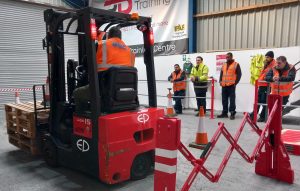
Hands-on operation of the new truck type under instructor supervision. Operators learn handling, manoeuvring, and safe stacking/de-stacking specific to the model. - Testing and Certification
Each delegate completes both theory and practical assessments. Successful candidates receive certification valid across the UK. - Flexible Delivery
We offer conversion training on-site at your premises or at our training centre in Maidenhead
Our qualified instructors make sure every operator leaves confident, competent, and compliant — ready to operate safely and efficiently from day one.
Final Thoughts
Experience is invaluable, but it’s no substitute for proper qualification. Each forklift type presents unique handling characteristics that must be learned and mastered.
By investing in conversion training, both operators and employers stay safe, compliant, and productive.
If you’re looking to upgrade your team’s forklift skills, contact PD Training today to discuss our conversion courses for reach, counterbalance, pivot steer, and other truck types.
Call us on 01344 830015 or visit pd-training.co.uk to book your next course.